
Working on a Master Stonemason’s Virtual Assistant Role: What This Job Actually Looks Like
A few months back, a friend of mine took a VA gig supporting a high-end craftsman, and she called me halfway through her first week completely overwhelmed. Not because the work was hard, exactly, but because nobody tells you how different it is supporting someone in a creative, hands-on trade versus supporting a typical office manager or startup founder. I ended up helping her sort out her workflow, and that experience is basically why I wanted to break down this Ian Knapper Virtual Assistant listing in detail.
If you’ve never worked with a master craftsman before, this role is going to feel unfamiliar in some good ways and some genuinely tricky ways. Let me walk you through what you’re actually signing up for.
Why This Role Is Different From a “Normal” VA Job
Most virtual assistant postings you see online are for coaches, agencies, or e-commerce sellers. This one’s supporting an internationally recognized master stonemason who builds bespoke stone staircases and luxury fireplaces. That matters more than you’d think.
You’re not just managing a calendar. You’re managing the calendar of someone whose clients are often architects, interior designers, and homeowners investing serious money into a one-of-a-kind piece. The tone of every email, every scheduling conversation, every follow-up needs to match that level of polish. There’s very little room for “oops, wrong date” type mistakes here.
My friend’s biggest early lesson? She sent a slightly casual email to a client who turned out to be working with a well-known architecture firm. It wasn’t rude, just a bit too breezy. Her employer gently corrected her tone, and after that she kept a “voice guide” doc — basically notes on how formal to be, which clients preferred short emails versus detailed ones, that kind of thing. Something as simple as a shared Google Doc saved her a lot of guesswork.
What the Pay Actually Looks Like
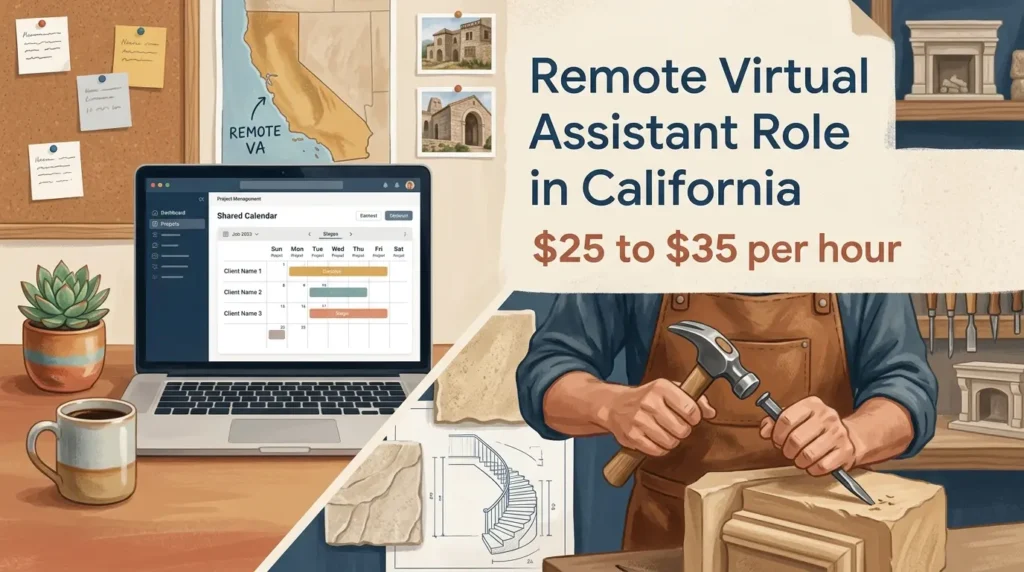
Based on the listing, you’re looking at $25 to $35 per hour, with $30 sitting as the median. For a remote administrative role, that’s honestly solid pay, especially if you’re in San Diego, where the cost of living isn’t cheap. It’s full-time too, not a scattered few hours here and there, which means more stability than a lot of freelance VA work offers.
If you’re coming from general VA work where $18-22/hr is more typical, this is a step up — but it also comes with higher expectations. You’re being paid more because the margin for error is smaller.
Click the button below to submit your application directly for this position.
Breaking Down the Actual Responsibilities
Let’s go through what you’d really be doing day to day, because the job posting language can feel a bit vague until you picture it in action.
Calendar and scheduling. This isn’t just “add meeting to Outlook.” You’re coordinating between the stonemason’s project schedule (which depends heavily on things like material deliveries and site visits), client availability, and supplier timelines. Things shift constantly in construction and design work, so flexibility matters more than rigid scheduling skills.
Email correspondence. You’ll likely be the filter between Ian and a lot of inquiries — some serious, some just tire-kickers wanting a quote for a project that isn’t realistic for his level of work. Learning to tell the difference (politely) is a skill you build over the first few weeks.
Document prep. Expect proposals, project summaries, maybe even client-facing presentations. If your Excel and Word skills are rusty, brush up. Google Workspace fluency helps too, especially Google Docs and Sheets for shared tracking.
First point of contact. This one’s big. You’ll be the voice representing a luxury brand before anyone even talks to Ian directly. That means your written English needs to be clean, warm, but professional — not stiff, not overly casual either.
Project coordination. You won’t be swinging a chisel, obviously, but you’ll be tracking timelines, checking in on progress, and making sure nothing slips through the cracks. A simple tool like Trello, Asana, or even a well-organized spreadsheet can be a lifesaver here if the business doesn’t already have a system in place.
Research. Sourcing suppliers, comparing materials, looking into potential business leads. This part is actually kind of fun if you enjoy digging into details — think of it like being a detective for stone quarries and metalwork suppliers instead of crime scenes.
Confidentiality. Worth repeating because it’s listed explicitly — high-net-worth clients value discretion. Don’t be the person who mentions a client’s name in a casual LinkedIn post.
Step-by-Step: How I’d Approach the First 30 Days in This Role
If I were stepping into this job myself, here’s roughly how I’d structure my first month.
Week one, I’d focus purely on observation. Read through past email threads (with permission), understand who the regular clients and suppliers are, and get a feel for Ian’s communication style before sending anything on his behalf.
Week two, I’d start handling low-risk tasks — calendar updates, simple scheduling, maybe drafting emails for his review before sending. Building trust slowly here pays off later.
Week three, I’d set up (or improve) whatever tracking system exists for projects and supplier research. Even a basic shared spreadsheet with columns for project name, stage, next action, and deadline can prevent a lot of confusion.
Week four, I’d start taking more ownership — handling client replies directly, managing the calendar independently, and checking in weekly with a summary of what’s been done and what’s pending.
This gradual build-up matters because trust in a small, high-end business isn’t handed over on day one. It’s earned through consistency.
Common Mistakes People Make in Roles Like This
Being too casual in writing. Even if you’re a naturally friendly communicator, luxury clients often expect a more polished tone. It doesn’t mean cold or robotic, just intentional.
Overpromising on timelines. Construction and craftsmanship projects shift constantly. If you tell a client “definitely next Tuesday” without confirming with Ian first, you’re setting everyone up for an awkward walk-back.
Not asking enough questions early on. It feels like you should already know everything, but in a role this specialized, asking smart questions in week one saves you from bigger mistakes in week three.
Letting research go shallow. When looking into suppliers or materials, don’t just grab the first Google result. Cross-check reviews, pricing, and reliability — your employer’s reputation depends partly on the vendors you help select.
Ignoring the “small team” dynamic. This isn’t a massive company with a dozen departments to lean on. You might be one of just a few people supporting the entire operation, so your reliability carries real weight.
Tools Worth Knowing Going In
Given the listing mentions Microsoft Office and Google Workspace specifically, it’s worth being genuinely comfortable — not just “I’ve used Word before” comfortable — with things like mail merge, shared calendars, and basic formula work in Excel or Sheets. If project tracking tools like Asana or Trello come up, even a free-tier familiarity helps you hit the ground running.
A tool like Grammarly can also quietly save you from small errors in client-facing emails, especially in the early weeks when you’re still calibrating tone.
Is This Role a Good Fit for You?
If you’ve supported a creative professional before, or worked in real estate, interior design, or construction-adjacent admin work, this role will feel familiar in the best way. If you’re coming from a very corporate or tech-startup VA background, there’s a bit of a mindset shift needed — less about speed and automation, more about relationship management and craftsmanship-level attention to detail.
Either way, it’s a legitimately good opportunity. Full-time, remote, decent pay, and the kind of role where you’re genuinely trusted with meaningful responsibility rather than just being an inbox filter. My friend, a few months into her similar position, told me it’s the first VA job where she actually feels like part of the business rather than just support staff sitting outside it.
If you land this one, give yourself grace in the first few weeks. Nobody walks into supporting a master craftsman’s business and gets everything right immediately — and that’s completely normal. If you’re ready to turn your skills into income, check out our full guide on Lidl Store Associate Jobs in New York State.